Welcome to Loganberry Books!
Hours: Mon, Tue, Wed, Fri & Sat 10-6; Thur 10-8:30; Sun 12-5 - We'll close at 2pm 4/8 for eclipse!Loganberry Books is an independently owned & operated bookstore in the historic Larchmere neighborhood of Cleveland, Ohio. Established in 1994, we feature a carefully curated collection of new, used & rare books in all genres for both readers and collectors, with an inventory of over 100,000 volumes (give or take - we're still counting!). Browse our shelves, check out our event calendar, sign up for our monthly email news, order a book, or learn about our history. If it isn't listed on our (imperfect, homegrown) online store, we have affiliate sites that can help you order almost any book in print, eBooks, or audiobooks (see links below). Or just give us a jingle (phone/email) or come by and see us! Please see our directions page for accessibility information.
Loganberry Books' Online Store
a mere selection of our new, used & rare books
Comprehensive in-print catalog via an indie-friendly partner
direct ship from the warehouse
Collectible Books via consortium
selections from our Sanctuary

Extensive audio books catalog via an indie-friendly partner
Annex Gallery
Altered Book Group, Circles and Cycles
Opening Thursday, April 4, 6:00–8:00pm
The Altered Book Group is a local book-artist organization. These artists twist, cut, and bend books to make visual art out of literary art. Six women artists meet monthly to share their work and exchange ideas. They are committed to the individual exploration of the book as art. As altered book artists, they transform the original content or structure of books into unique, purposeful or whimsical expressions using a variety of materials and techniques such as collage, assemblage, stitching, painting, printing, and sketching, often pushing the boundaries of the book as a recognizable object.
The Altered Book Group is comprised of local artists Jane Berger, Phyllis Brody, Gene Epstein, Amy Jacobs, Pat Pitingolo, and Anne Weissman.
✶ This exhibit is on view 4/4/24 - 4/28/24 ✶
Upcoming Events
Stump the Bookseller
Have you forgotten the title of your favorite children’s book? This is a service to help solve your book mysteries. Submit your memory here, and see if anyone else remembers your book memory, or better yet, knows the title and author! After all, it’s easier to find the book when you know what it’s called. Read the blog.
Read with us!
Join us on Instagram for the #broadenyourbookshelf24 #readingchallenge.
One prompt per month.
April prompt: #AnalogApril
Read books written or set before 1981 (the year that personal computors started to become wide-spread) and share all that historical knowledge (!)
with fellow readers!
April Sale!

To celebrate National Poetry Month, we’re offering 20% off our Poetry section all month long! There are classics and new gens, along with poet's biographies and memoirs--enough to keep any poetry lover busy all April and beyond. Also, we’ll have free poetry coasters for customers all month long (you needed a pocket poem, right?).
Book Club News
We've got Storytime for Toddlers, For the Thrill of Lit, Magical Realism, and Rebel Readers! Plus, the ongoing Murmurations club at Abide Yoga down the block. In early May the Democracy Book Club will be back on Thursday afternoons!
And - Save the date for our first Book Club Open House
Sunday, September 29, 2024
This will be a special opportunity for book clubs and people wishing to join them to mingle, shop, and learn about great books. More info here!
See the Discussion Groups page for more info on all the social reading opportunities!
Small Press Highlight
We still have Sibylline books up for a few more days in early April - find books by brilliant women over 50 in our Small Press Highlight display!
 April: O/R Books
This small press located in New York City focused on books about progressive politics and culture, and devoted to disrupting "Amazonian hegemony." They publish 1-2 books a month and are a print-on-demand supplier, helping to lessen publishing waste.
We'll have a number of their titles on display this month, so be sure to come and browse!
Best Bookstore, Scene Magazine 2015, 2017, 2019, 2022 & 2023!
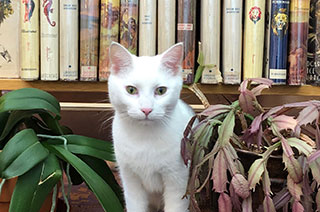
Best Shop Cat, Alice! Cleveland Magazine 2023